CHANGEMATE
A social event platform connecting nonprofits and volunteers, designed solo from research to a tested hi-fi prototype — reaching 100% task completion in the second round of usability testing.
The problem
Volunteering lost its network effect
Post-pandemic, volunteer rates declined as people changed how they socialize. Organizations struggle to find helping hands; would-be volunteers struggle to find causes. CHANGEMATE explores how a mobile-first, user-centric platform could reconnect the two.
Research
From screener survey to affinity themes
A screener survey to volunteer groups (12 responses) yielded 5 qualified participants for moderated interviews. Affinity mapping surfaced six recurring themes: transparency about events and organizations, engagement barriers, convenience, personalization, visibility of opportunities, and reward/gamification. A heuristic analysis of Engage, Nextdoor, and Eventbrite showed why traditional nonprofit tools lose to modern social products.
“Nonprofits should be more accessible. A lot of places need help but don't broadcast enough, while some sites still have outdated listings.”— User interview
Design
Two personas, three critical flows
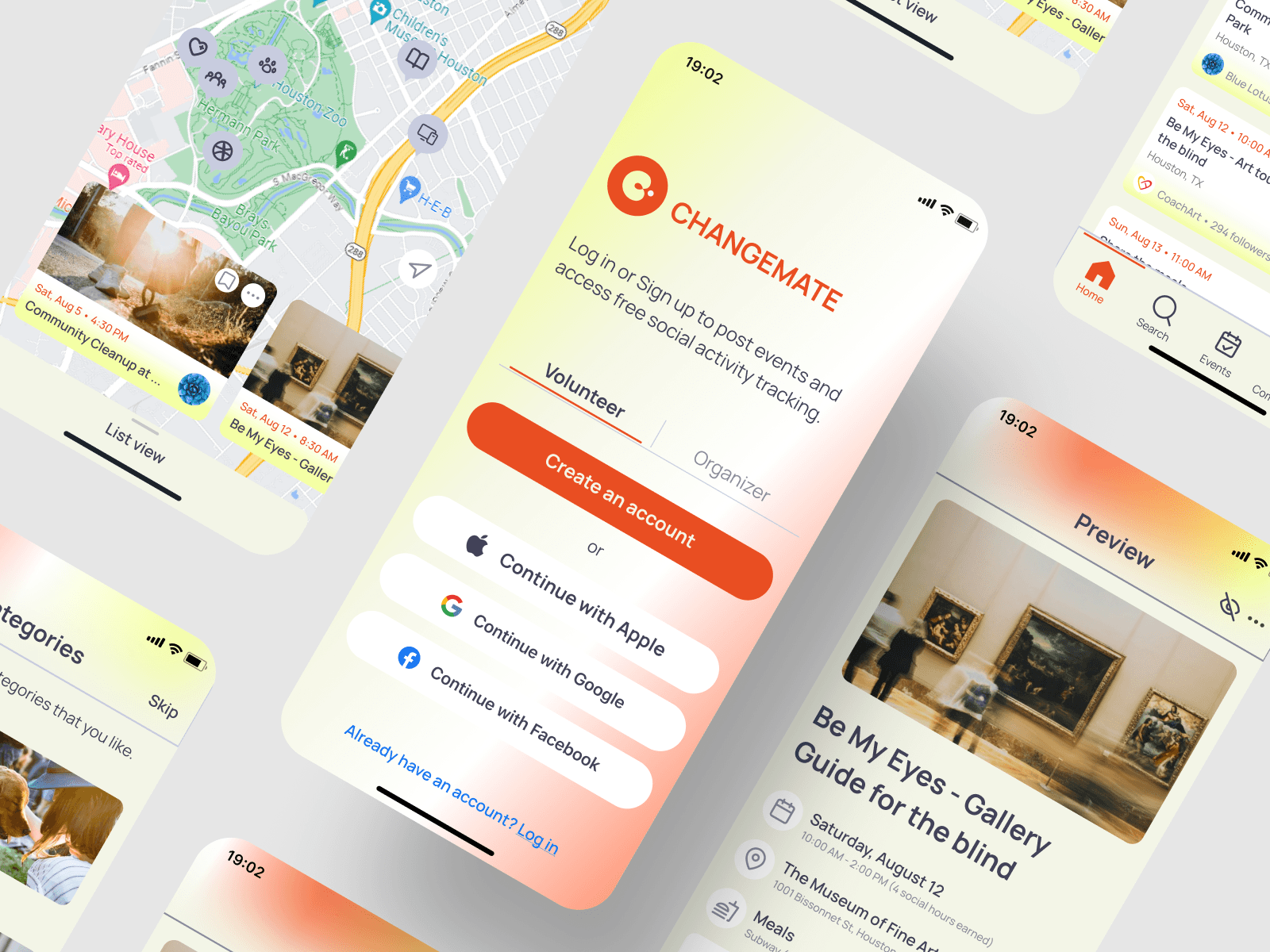
User-story maps for two perspectives — the volunteer seeking credit-worthy local activities and the organizer recruiting for clients — defined the MVP: onboarding & account setup, applying for an opportunity, and creating an event. Napkin sketches were digitized into a clickable POP prototype for five guerilla tests, then iterated into wireflows, a full visual identity, and an accessibility-checked design system.
Validation
Test, iterate, repeat
Two rounds of moderated usability testing with 10 participants (7 active volunteers). Round one surfaced three critical issues:
✗ Confusing sign-up and identity-verification steps during account creation — round 1
✓ Round 2: 100% completion — all 5 participants reported feeling more in control during account creation
✗ Ambiguous options when applying for an opportunity — round 1
✓ Round 2: 100% completion on the application flow
✗ Misleading language on key actions — round 1
✓ Round 2: reworded; create-an-event flow reached 80% completion
Reflection
Designing in a silo, learning to leave it
Research debunked my early assumptions about user preferences — a lesson in letting go of preconceptions. Resistance to a design element in testing, initially disheartening, became the project's most valuable iteration. And working solo taught me the opposite of solo work: the earlier you involve developers, stakeholders, and other designers, the better the outcome. Next for CHANGEMATE: gamification and auto-tracked volunteer hours.